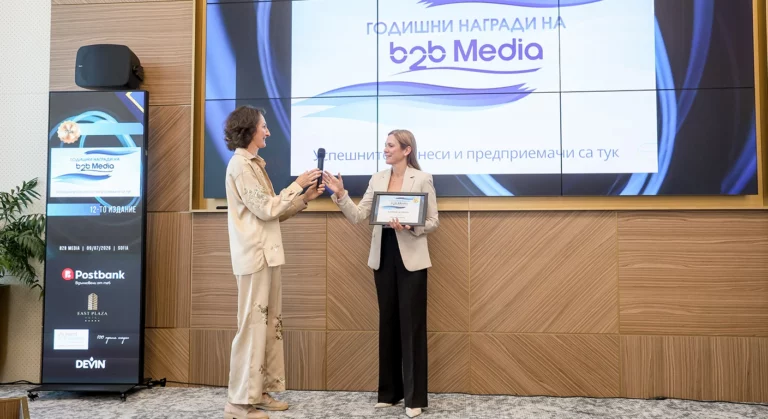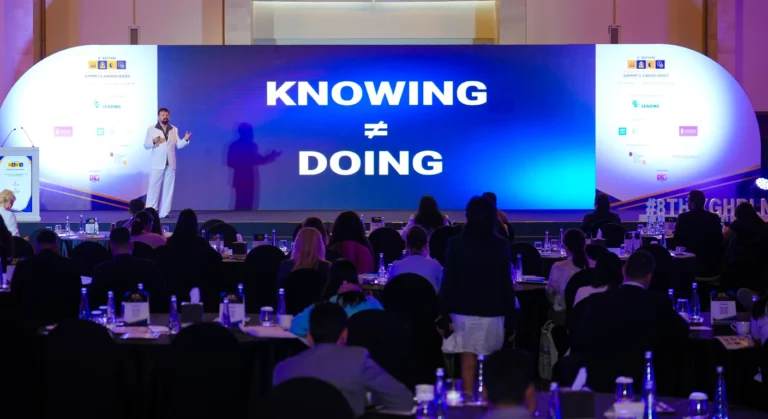


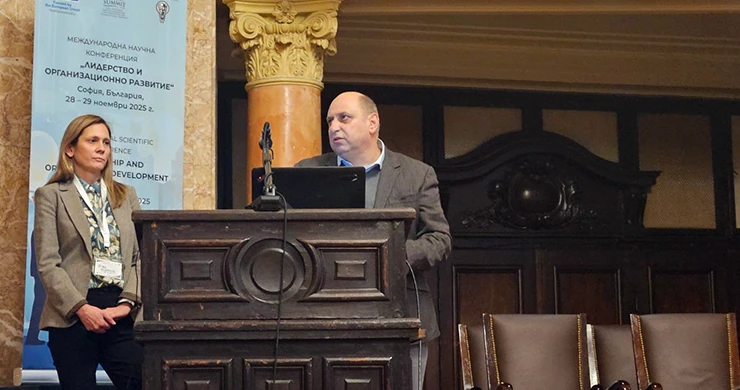
Nina Koynova, General Manager, Lean Digital Solutions/ Blended Leading, was a lecturer during the panel “LEADERSHIP AND ORGANIZATIONAL CHANGES MANAGEMENT”
What happens when leadership science meets AI technologies?
At Blended Leading, this question is not just theoretical, because it’s the foundation of our product. This November, our team took that foundation to the international scientific community, presenting original research that validates the leadership competency model powering Blended Leading’s AI-driven development engine. During our panel, we shared how scientific validation transforms feedback, open comments, and real-world data into meaningful and personalized guidance for leaders.
Sofia, 29 November 2025
Blended Leading was featured at the International Scientific Conference “Leadership and Organisation Development”, held in Sofia on 28–29 November 2025. The event, organized by the Center for Leadership and Organizational Development at the Department of Social, Organizational, Clinical, and Pedagogical Psychology at the Faculty of Philosophy of Sofia University “St. Kliment Ohridski” and the Association of Psychologists in Bulgaria, brought together leading academics and practitioners in the fields of organizational psychology, human resources, leadership development, and the future of work.
Our panel contribution, delivered by Nina Koynova (Lean Digital Solutions EOOD.) and Nikolay Nikolov (Prometriks Ltd.) focused on a core component of the Blended Leading project:*
Validation of a Generic Model of Leadership Competencies
Why We Participated
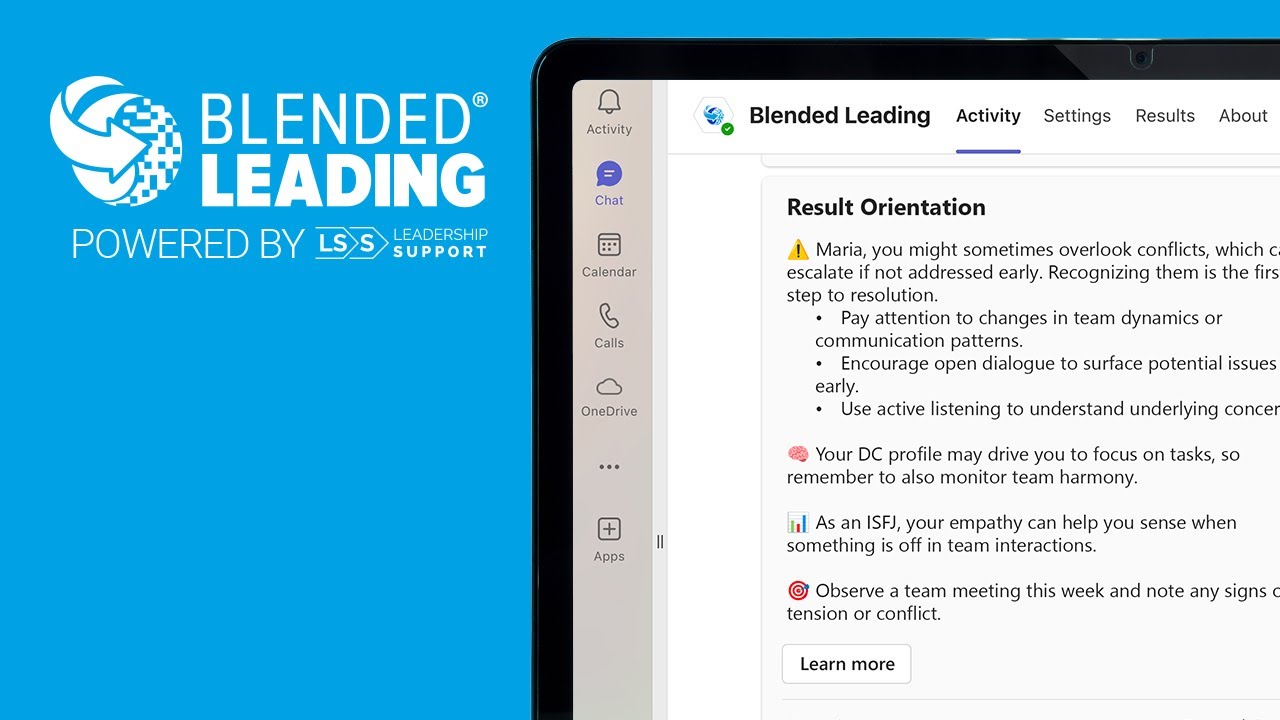
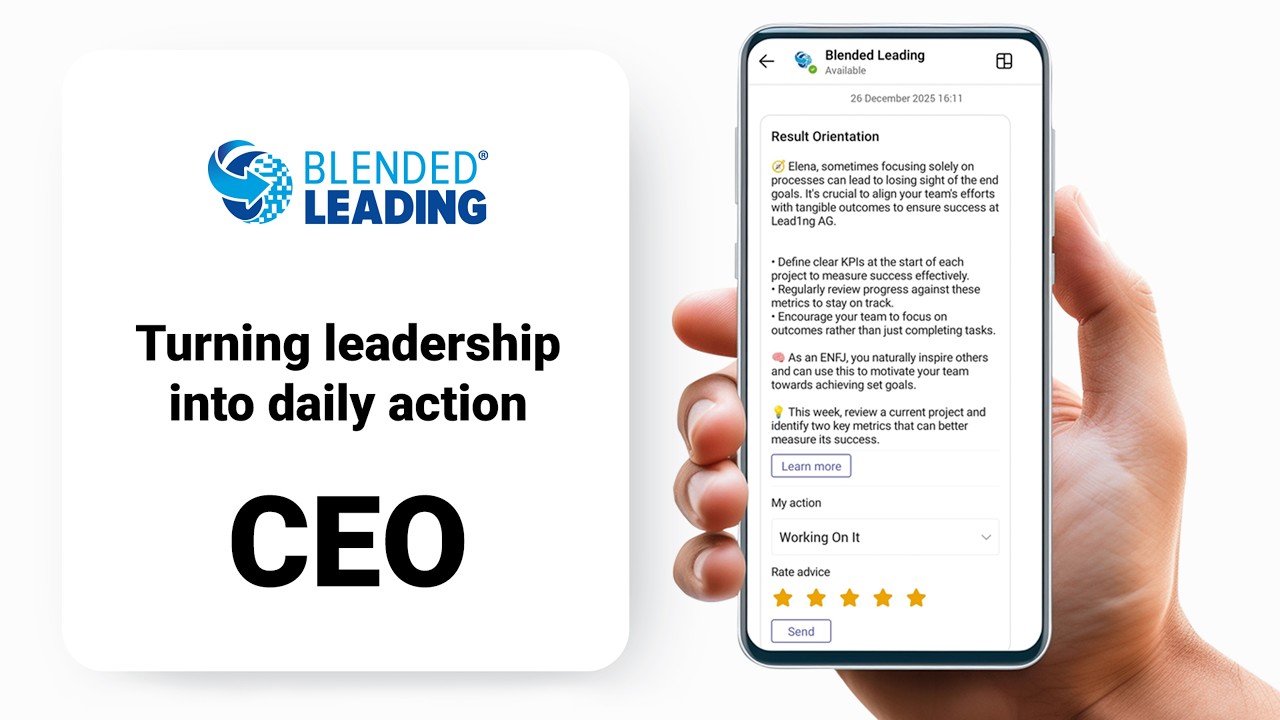
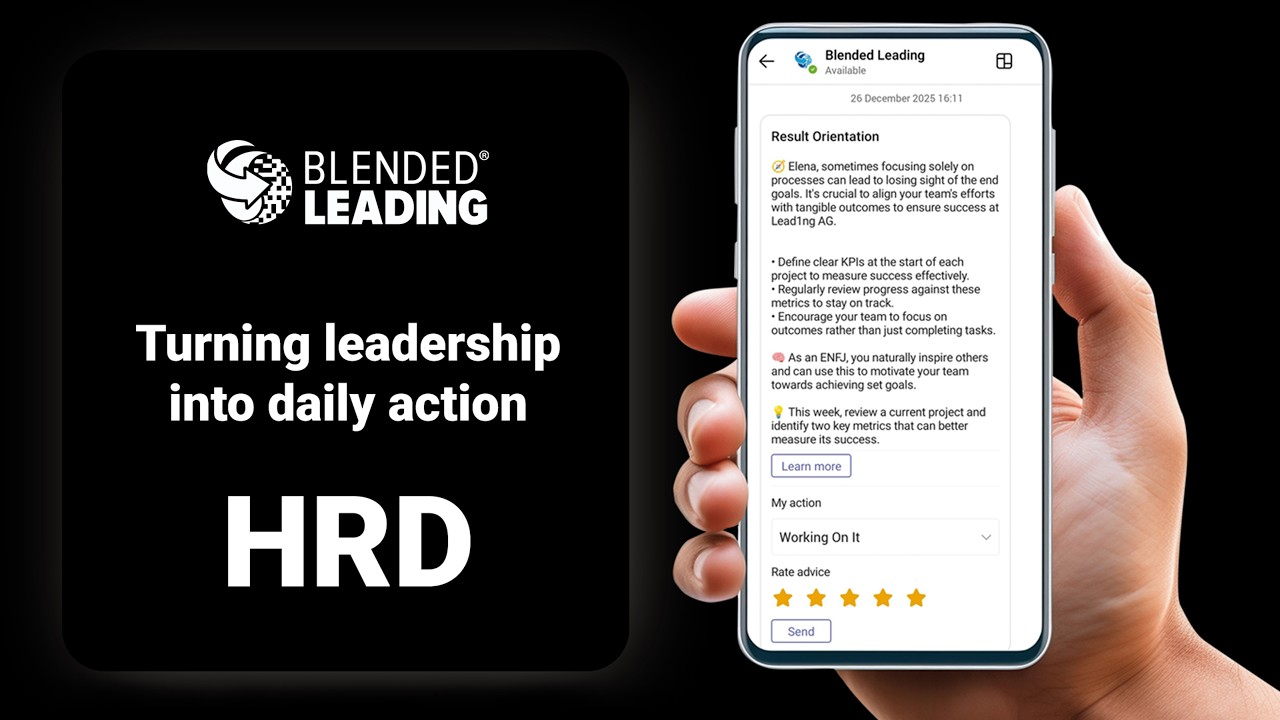
Blended Leading is built on the belief that modern leadership development must be scientifically grounded, data-driven, and deeply contextualized. As part of our Next Generation EU-funded project (“Embedded Blended Leadership Environment,” № BG-RRP-2.006-0013-C02), we are developing an AI-enhanced system that supports leaders directly inside Microsoft Teams through personalized nudges, feedback interpretation, and targeted micro-development.
To ensure this system works reliably across industries, cultures, and organizational contexts, we needed a rigorously validated, universal leadership competency model that can serve as the foundation for our AI architecture.
Our academic participation was an important step in the validation of the leadership competencies model during a scientific event. It will be followed by a research paper publication in the journal “Leadership and Organizational Development” by the University Publishing House “St. Kliment Ohridski”
Science at the core of Blended Leading
The validation of the Generic Leadership Competency Model was grounded in an empirical dataset, ensuring practical relevance. The model integrates 40 foundational leadership competencies, each representing core behavioural expectations derived from extensive literature and updated to reflect contemporary managerial demands. Its validation was conducted on a diverse sample of 5,002 individual ratings assessing 669 leaders across 14 organizations, including businesses from multiple industries, a private school, and a public-sector institution. This broad and heterogeneous dataset confirmed the model’s universal applicability, demonstrating that the competencies hold consistent meaning and predictive value across sectors, cultures, and organizational contexts.
The process began with in-depth interviews with 10 experts in human resource development, followed by a pilot study across five organizations (three businesses, one private school, and one public institution) allowing the model to be tested in diverse real-world contexts. Based on the evidence gathered, the initial set of 48 competencies was streamlined to 40, with substantial improvements to the clarity and precision of behavioural indicators.

Our presentation outlined a multi-stage validation process that combined deep academic review and large-scale empirical analysis:
- A systematic literature review of over 1,700 scientific publications spanning decades of research in leadership and organizational psychology.
- Integration of foundational competency theory (building on models by Borman & Brush, Tett et al., and others).
- Quantitative analyses confirming that:
- the one-factor structure of leadership competence is statistically robust and replicable;
- the 40 leadership competency areas reliably contribute to overall effectiveness;
- modern capabilities like digital leadership, AI adoption, virtual team management, agile leadership, and matrix leadership strengthen the model’s predictive power without altering its fundamental structure.
This rigorous scientific grounding means that Blended Leading’s AI agents do not just generate suggestions. They interpret leadership behaviour through a validated psychological lens. In this way leaders get guidance that is both empirically anchored and context aware.
How the Competency Model Powers the Blended Leading Platform
Here is why Blended Leading is more than a leadership app, but a data-driven development engine.
| Contextual Intelligence | Blended Leading uses multiple company data sources (including 360-feedback reports, psychometric tests, and unstructured text), then applies the validated competency framework to interpret and prioritise insights. |
| Our AI Agents are trained on your organizational DNA | The platform trains its AI models with each organization’s own values and competency language, so nudges feel native, relevant, and actionable rather than generic. |
| Personalized Nudges in the daily workflow | Leaders receive short, targeted recommendations that help them practise specific behaviours in real time, right where they communicate and make decisions. This supports continuous development rather than delayed, abstract feedback. |
| Meaningful impact at scale | By embedding evidence-based insights into daily routines, Blended Leading helps HR and L&D teams scale development across large leadership populations without overwhelming internal coaches or mentors. |
Even the most advanced AI tools must be grounded in validated science. That’s why our research focused on ensuring the underlying competency framework used by Blended Leading is empirically supported.
Looking Forward
Being part of the “Leadership and Organisation Development” conference reinforces our commitment to evidence-based innovation. As we continue enhancing Blended Leading, we will publish more findings and keep you updated about the next phases of our research work.
*part of the Blended Leading project “Embedded Blended Leadership Environment” funded by Next Generation EU, under the National Recovery and Resilience Plan (NRRP) № BG-RRP-2.006-0013-C02